Visit the Home,
            Kitchen and Lawn
            Christmas Corner
Showing posts with label gathering. Show all posts

Gathering Wild Leeks (Ramps)

growth habit of wild leeks wild leek growth habit (photo by jhy)

Wild leeks, Allium tricoccum, also known as ramps, appear early in the spring in April or May, about the same time of year as the hepatica and spring beauty bloom. You will find patches of them in the woods. They grow like this.

They don't have many look-alikes. Clintonia (bluebead) leaves are similar, but the tips of the Clintonia leaves are rounder. Leeks have purplish stems. And the clincher is, that if you break and crush a stem, it will smell like onion.

wild leeks wild leeks (photo by jhy)

You will need to dig up the plants. Usually, they will just break off if you try to pull them up, and you definitely want the bulbs. Once you have determined how deep you need to dig, just bring up a handful and knock most of the dirt off until you can wash them. You can carry them home in a paper or plastic bag.


To clean: Once they are thoroughly rinsed, I cut off the root ball (leaving the bulb, of course), and then just slide the outermost "skin" down over the bulb to remove any remaining dirt or residue.

wild leeks ready to take home wild leeks ready to take home (photo by jhy)


Harvesting Autumn Olive


Autumn Olive berries are edible and delicious if they are harvested after the first hard frost. This causes the sugar to move into the fruit. Watch the video for a demonstration of picking the berries.

Plant identification post coming soon.


Identifying Shaggy Mane Mushrooms

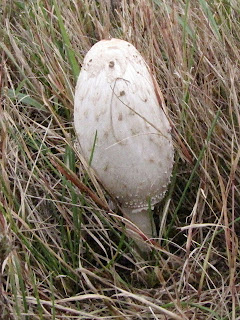
young shaggy mane mushroom young shaggy mane mushroom (photo by jhy)
Shaggy Mane mushrooms are one of the easy-to-identify species. Beginners can't really get in trouble with this if they are paying attention. The top picture is what the mushroom should look like when you collect them- a tall (about 3-4 inches tall) oval with shaggy, curled edges- sort of like old shingles- on the outer layer. This appearance also gives it the common name of Lawyer's Wig.

The scientific name is Coprinus comatus, and it is one of the strange self-digesting mushrooms. This will give you the means to positively identify it. This also means that if you find some, don't go back another day to collect it, because it will be unusable, if not gone. The black parts are not poisonous, but the good flavor is ruined.

mature shaggy mane mushroom mature shaggy mane mushroom (photo by jhy)
As the cap opens out you can see that it is already turning black, and there are stringy threads "flowing" down the outside. At this point it's way too late to eat. However, this appearance, coupled with the tall oval shape of the young mushrooms, will guarantee that you've found the correct species.

It grows in lawns and waste places, and you may see fruiting bodies from spring through fall. I've usually seen them from August onwards, but they can appear earlier. Avoid eating mushrooms that are growing in soil that is polluted- for example, a brownfield. The only real lookalike is Coprinopsis veriegata (also known as Coprinus variegatus and Coprinus quadrifidus and Coprinus ebulbosus. Taxonomy is in real flux with DNA testing.) The lookalike tends to grow on logs, not from the ground, and is not as white. It is also edible, so this is not a deadly mistake, but some references say to not consume alcohol with the lookalike.

self-digested shaggy mane mushroom self-digested shaggy mane mushroom (photo by jhy)
These Shaggy Manes are almost completely gone. The self-digestion process has continued until there is only a tiny cap left, and strings of the black "ooze."

Collect the white, shaggy ovals, and use right away. They will self-digest even after picking, sometimes within a few hours.

If you find a place where they grow, visit it each year because the underground mycelium will keep sending up the fruiting bodies (the part you see) annually.


Found a Yellow Crabapple Tree


yellow crabapple tree yellow crabapple tree (photo by jhy)
This tree was literally in the ditch. I was driving down a country road and saw yellow fruits, about an inch in diameter flash by. I resolved to stop there on my way home. I did just that, and found a yellow crabapple tree. Until a couple of weeks ago I didn't know they exist. Now I know that there are several varieties, although I'm not sure which one this is. I suspect it may be the cultivar "Golden Hornet."

yellow crabapple fruits yellow crabapple fruits (photo by jhy)
That is described as having huge crops of conspicuous yellow fruit with branches bending under the weight. These obviously ripen much later than the red crabapples, as they are just now turning golden. They are often planted simply to be ornamental, since the fruits stay on the branches through the winter. Apparently, they are also a good tree to plant with other apples to aid with cross-pollination.

I sampled one and brought a few home. The fruit is much sweeter than red crabapples. It's almost like a golden delicious apple. Of course, what I love about the red ones is their tart taste, so I don't think these will make my list of favorites.

yellow crabapple fruits yellow crabapple fruits (photo by jhy)
The ones I brought home turned completely yellow in two days and are beginning to get spots already. I cut them up in pieces to eat on my yogurt this morning.


Gathering Wild Grapes


Wild grapes are good for a number of food products. There are several varieties, and they are all fine for use. In the video, I'm collecting summer grape, Vitis aestivalis, but fox grape, frost grape, riverbank grape (and others) are all fine too. Experts recognize between 19 and 35 species of native North American grape, and the taxonomy is probably changing as we speak. They are all fine to use.

Wild grape fruits grow in clusters, just like domestic grapes, but the fruits will be smaller. They are also much more acid (sour). Some years they are sweeter than others. In any case, wait until after the first frost before collecting them, because they will be sweeter then.


In the video I suggest using scissors to cut off the clusters, which works well, but they can just be broken off by hand. I found a vine that was covered when I was out and about yesterday, and collected a pail full in just a few minutes, by hand.

In any event, the fruits are small, and unless it's an exceptionally good year there will be more waste than with commercial grapes, so be sure you collect lots!


VISIT MY OTHER BLOGS